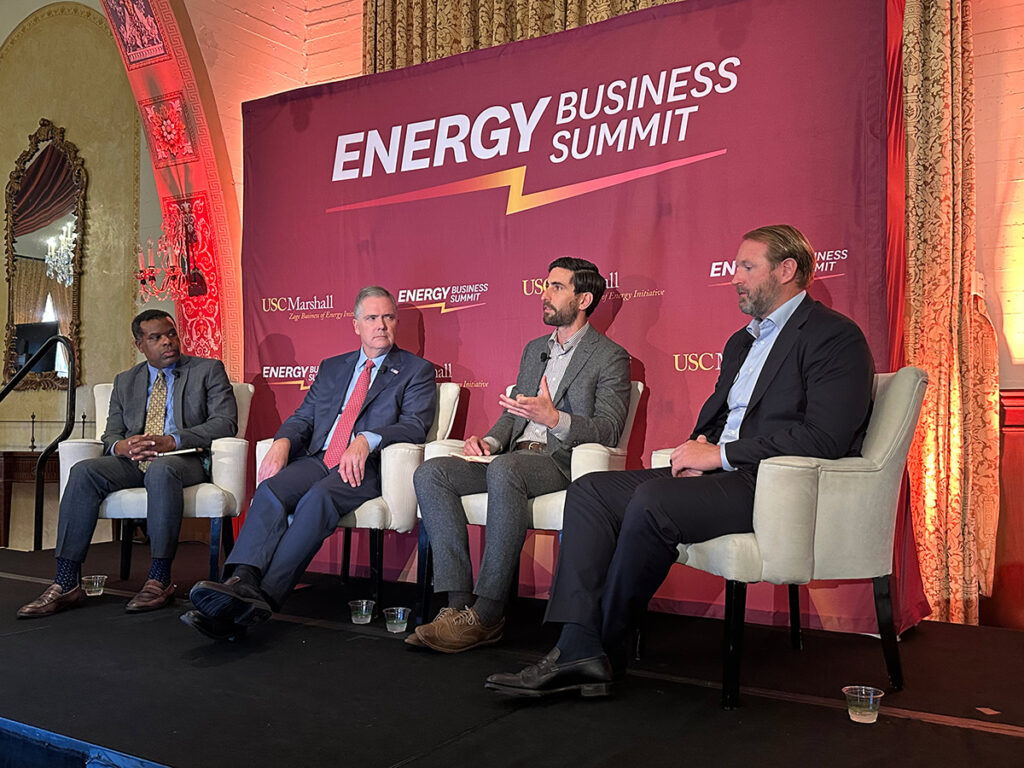
Key Insights from USC Marshall’s 2025 Energy Business Summit
By Michael Grimm, SVP, Reputation Partners
The race to power AI is reshaping the energy landscape. Data centers are proliferating, electricity demand is surging, and utilities are scrambling to keep pace. And while the technology is ready and capital is available, one obstacle keeps stopping projects cold: community trust.
That was the consistent theme I heard at the USC Marshall’s 2025 Energy Business Summit, where nuclear, natural gas, critical minerals, and data center executives gathered to discuss the future of energy. The verdict was unanimous; stakeholder engagement will be critical to determine which projects move forward and which stall indefinitely.
Consider the ripple effect already unfolding. In Indianapolis, Google walked away from a $1 billion data center proposal after local leaders pushed back. In Wisconsin, Microsoft paused a similar project amid rising community opposition. Bloomberg data shows that 70 percent of grid nodes with price spikes sit within 50 miles of major data center hubs, and even Baltimore residents, more than an hour from Virginia’s “Data Center Alley,” report electricity bills up nearly 80 percent.
The pattern is clear: communities are linking soaring energy costs with the infrastructure meant to power the digital economy, creating a reputational risk that threatens to slow the entire energy transition. This opposition reflects a familiar dynamic: NIMBY (Not In My Back Yard) sentiment has existed for decades affecting a variety of initiatives, including infrastructure projects, from highways to power plants. Today’s energy transition simply represents its latest manifestation, as communities weigh the local impacts of projects designed to serve broader regional or national needs.
As one panelist warned: “The last thing we need is public backlash against data center build-out or AI… it just makes it that much harder for the U.S. to excel in this energy race.”
The Challenges Emerging Across Energy Sectors
Public Perception
“The biggest risk we actually face is public perception going poor,” noted John Hopkins, President and CEO of NuScale, a nuclear company developing small modular reactor (SMR) technology. Despite modern SMR designs with minimal footprints and exceptional safety records, the nuclear industry needs more sophisticated strategies to translate technical excellence into community trust.
Mark Caine, Senior Lead of Energy & Climate at Google, acknowledged the same challenge from the data center side: “It’s really a high priority for us to be a good grid citizen and make sure we are helping offset any local costs.” But when Baltimore residents ask, “how is AI going to help me pay my bill?” Even sophisticated corporate efforts need reinforcement through broader stakeholder strategies.
Infrastructure and Permitting
Toby Rice, CEO of EQT Corporation, one of America’s largest natural gas companies, described the infrastructure challenge starkly: “Five BCF [billion cubic feet] per day of Appalachian pipelines have been cancelled or blocked. My mom in Boston will be paying the highest natural gas prices in the world, just 300 miles away from the biggest gas field in the world.” Infrastructure blocked by opposition, not engineering constraints.
Teague Egan, CEO of EnergyX, showed how his company can extract lithium 300% more efficiently, unlocking California’s Salton Sea reserves. But even breakthrough technologies require community support before permits are approved.
Community and Economic Impact
Hopkins emphasized the jobs dimension that often gets lost in technical discussions: “The issue is jobs. Local communities want to save their jobs, they don’t want to move their families, they need tax revenue.” Understanding these priorities shapes how projects should be designed and communicated from day one.
Dennis Cornell, Partner at Apollo Management Group, highlighted reputation’s direct impact on capital: “Financial sponsors got out of upstream oil and gas because their LPs [limited partners, the pension funds, endowments, and institutions that invest in private equity] didn’t like hydrocarbon problems.” Investors won’t fund projects facing activist pressure, regardless of returns.
A Successful Path Forward
These challenges require multifaceted solutions. While engineering excellence, competitive economics, and supportive policy all matter, stakeholder engagement deserves the same strategic rigor.
Here are recommendations for the energy industry to navigate these reputational challenges:
1. Map Stakeholder Networks Before Breaking Ground: Understand who influences permit decisions early. Successful projects map stakeholder networks, measure community sentiment, and identify potential concerns before opposition organizes.
2. Translate Technical Achievements Into Business-Centered Impact: Many energy projects benefit from bipartisan support today. The nuclear industry panelists especially echoed this. The most effective communications translate technical achievements into business and community outcomes that resonate across the political spectrum, demonstrating community benefits while avoiding polarization.
3. Build Coalitions, Not Monologues: No company builds trust alone. Successful projects identify and activate credible validators: local officials, community leaders, labor unions, and economic development agencies who authenticate impact and broaden support. Rice’s pipeline cancellations show what happens when opposition organizes faster than support coalitions form.
4. Demonstrate Tangible Local Value Early: Leading organizations demonstrate tangible local value before opposition develops, through community benefit programs, workforce development, or economic impact initiatives that build genuine local support.
5. Track Community Metrics Like Engineering Metrics: The best-run projects track community sentiment, permit timelines, and stakeholder relationships alongside engineering performance. Quantifying outcomes demonstrates clear ROI on stakeholder engagement investments.
The Bottom Line
The energy transition is no longer a technology challenge—it’s a trust challenge.
When billion-dollar projects stall over local opposition, when communities see their electricity bills spike, and when new technologies spark uncertainty instead of optimism, reputation becomes the determining factor of progress.
As one panelist put it, “the complexity of stakeholder interests is overwhelming.” Success in laboratories and boardrooms must now be matched by success in city council meetings, community conversations, and digital forums where perception is shaped long before a permit is filed.
The next decade will see hundreds of billions invested in nuclear plants, battery systems, natural gas infrastructure, and data centers. The organizations that move fastest will be mapping influence, measuring sentiment, and earning support before opposition takes root.
At Reputation Partners, this is exactly where our RP Impact approach comes in. We have helped clients anticipate reputational risks, build coalitions of credible supporters, and demonstrate tangible community value, turning complex infrastructure projects into trusted local partnerships. Our team has extensive experience navigating community acceptance and stakeholder pressure across diverse industries including manufacturing, healthcare, transportation, real estate, energy, infrastructure, and more—bringing cross-sector insights to every energy project we support.
Because in this new energy era, reputation isn’t just an outcome of success. It’s what enables it.
About Reputation Partners: Our RP Impact approach provides stakeholder intelligence, strategic communications, coalition building, and measurable outcomes that turn complex infrastructure projects into community partnerships. Schedule a complimentary strategy session to explore how stakeholder engagement strategies can support permit success and strengthen business fundamentals.